Tookish side
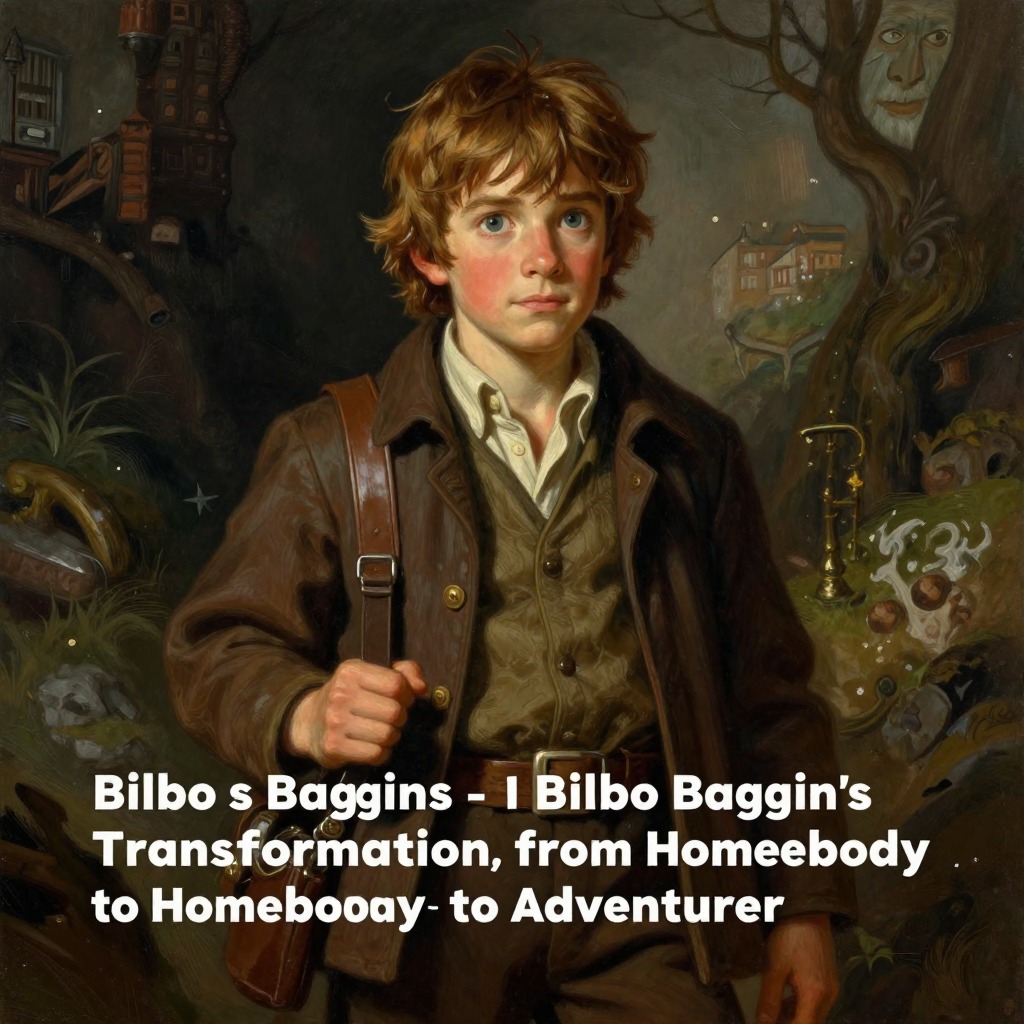
The Tookish side is the adventurous, un-Baggins-like strain in Bilbo Baggins's character, inherited from his mother's family, the Tooks. It is the inner force that, once awakened, drives him to accept and persist in the quest for the Lonely Mountain, repeatedly overcoming his natural hobbit love of comfort and respectability. This internal conflict between his Baggins and Tookish sides defines his character arc and is the psychological engine of the entire narrative.
Identity and Inheritance
Bilbo Baggins, the son of the solid and comfortable Bungo Baggins and the famous Belladonna Took, was born into a duality. The Bagginses were a very respectable family, rich and predictable, who "never had any adventures or did anything unexpected." The Tooks, by contrast, were not entirely hobbit-like; it was often said that one of their ancestors had taken a fairy wife, and members of the Took-clan would occasionally go on adventures, which the family would then discreetly hush up. Though Bilbo looked and behaved exactly like a second edition of his father, the narrator notes that he "got something a bit queer in his make-up from the Took side, something that only waited for a chance to come out." This latent Tookishness was the seed of all that followed.
Awakening and Conflict
The Tookish side first stirred during the dwarves' song in Bilbo's own hobbit-hole. As Thorin played his golden harp and the dwarves sang of the Lonely Mountain, "something Tookish woke up inside him, and he wished to go and see the great mountains, and hear the pine-trees and the waterfalls, and explore the caves, and wear a sword instead of a walking-stick." This surge of desire was immediately followed by a Baggins recoil: he thought of dragons and shuddered, and "very quickly he was plain Mr. Baggins of Bag-End, Under-Hill, again." The Tookish side won a decisive victory when Bilbo overheard Gloin's insulting remark that he looked "more like a grocer than a burglar." Stung, "the Took side had won. He suddenly felt he would go without bed and breakfast to be thought fierce." This moment of pride and defiance propelled him out of his door and into the adventure. Yet the conflict was ongoing; after the dwarves had all gone to bed, "the Tookishness was wearing off, and he was not now quite so sure that he was going on any journey in the morning."
Sustaining the Quest
Throughout the perilous journey, the Tookish side was the source of Bilbo's courage and resourcefulness. In the dark tunnels of the Misty Mountains, after finding the Ring, the "least Tookish part of him" lamented his folly in ever leaving home. Yet it was the Tookish part that enabled him to act. When he faced Gollum, a "sudden understanding, a pity mixed with horror, welled up in Bilbo's heart," and then, "as if lifted by a new strength and resolve, he leaped" over Gollum's head to escape. This blend of pity and decisive action is a hallmark of his Tookish nature in action. The Tookish side also manifested as a fierce and jealous love of beautiful things, a desire of the hearts of dwarves that moved through him during their song. This aesthetic longing was a key component of the adventurous impulse.
Resolution and Lasting Influence
By the end of the adventure, the Tookish side had been thoroughly exercised. Bilbo, having faced the dragon and the Battle of Five Armies, found that "the Tookish part was getting very tired, and the Baggins was daily getting stronger." His primary wish was to be in his own armchair. However, the Tookish side did not vanish; it was integrated into his character. In his later years, Bilbo remained an elf-friend, took to writing poetry and visiting elves, and was considered "queer" by his respectable neighbours. He was content, and his life was extraordinarily long. The Tookish side had not been suppressed but had become a permanent, if quieter, part of his personality, enriching his life without destroying his love for home. The adventure had proven that a Baggins could have an adventure and find himself doing and saying things altogether unexpected, and in the end, he gained something far more valuable than the neighbours' respect.